Friday, 23 November 2012

Current works in progress

I have spent the majority of the last couple of weeks in the woods, making stuff. I now have lots of items in their final stages, drying out before I can do the last finishing cuts. The wood is much easier to work when relatively green, but it takes a better finish once the moisture content has fallen.

I have enjoyed making some larger objects with the help of a curved adze and gouges.


Here is a selection of the items I have made recently, all unfinished: 3 spoons of willow and field maple, one spatula in striped ash, a blackthorn serving spoon, a large poplar platter, a kuksa cup and an eating bowl in apple wood.

Wednesday, 10 October 2012

Apprenticeship opportunity

As any of you who know me will be aware, I am a young craftsman based in the West Country, scratching a living from carving spoons, cups, Box wood crochet hooks, and other treen. I am fascinated by traditional crafts and woodland management and am determined that I will make a living from these things. Because of this I have decided to do an apprenticeship in the area of coppicing and green woodworking.

Coppicing is a form of sustainable forestry that has been practised for thousands of years. Deciduous trees are cut, low to the ground, and instead of the stump dying off, as would happen with most conifers, new shoots are sent out. If the woodland is managed well, these shoots will grow straight and true and will be cut again in later years when deemed sizeable enough for their intended usage. This form of management dramatically extends the life of individual trees, as they are kept in the juvenile stage of their life cycle and there are less stresses placed on the tree by weighty limbs.

This form of woodland management means that timber and other wooden products can be harvested from a woodland almost indefinitely, with little need for replanting. It is also very beneficial for wildlife. The soil is not disturbed and so delicate species of flora and fauna can flourish, many of which favour the various stages of a coppice rotation over full canopy coverage.

However, in recent decades this sort of management has declined, in favour of the short term return of conifer plantations and as other materials such as plastics replace wood in many aspects of life. Sadly, when a coppice woodland is abandoned it becomes overstood – the stems may grow too large and twisted to be useful for anything other than firewood, and the stools (coppiced trees) will begin to tear themselves apart, letting in rot and disease. In a relatively short time the woodland becomes unproductive and lacks the biodiversity of an in-rotation coppice. It is then a substantial undertaking for anyone wishing to again harvest a useful product from the woodland.
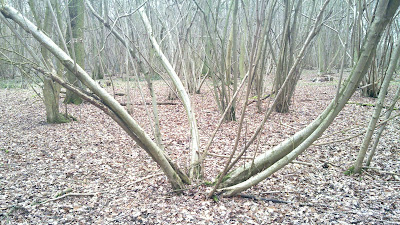
Coppice stool that has torn itself apart

As people are beginning to realise the threat of climate change and the part that an over reliance on fossil fuels and imported products plays in that, coppicing is once again becoming important. Coppice products can reduce our reliance on foreign imports of timber as well as providing us with locally sourced building materials, fencing, firewood, furniture, food and much more. It is necessary to revive this ancient, but still relevant practise, in order to become more sustainable and self-reliant as an island.

I have been making things out of wood for a good few years now, gradually honing my whittling skills, as well as getting out into the woods and trying as many different aspects of green woodworking as possible. Now I feel that the time has come for me to get my teeth into coppicing by training with an expert, so that I can practise the sustainable woodland management that I feel to be so important. Tim Gatfield at the Cherry Wood Project has agreed to take me on as an apprentice for a year, but to make this happen, I need to find the funding to support me in buying the tools, equipment and training necessary, as well as a small amount to cover my living costs for the year.
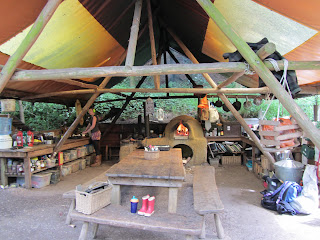
The Cherry Wood outdoor kitchen

During this year I would be restoring derelict coppice, by cutting overstood stools, replanting to increase the density, felling and milling conifers and deer fencing to protect the newly cut and planted trees. I would also learn many different aspects of green woodworking and related skills including making furniture, hurdles, bowl turning and earth oven building, as Tim runs many different courses in traditional skills.

By donating towards my apprenticeship fund you are helping to keep traditional skills alive and encourage sustainable woodland management. You can donate to my fund by clicking on the donate button on the right hand side of my blog.
Thank you for any contributions. 

Pete

Monday, 10 September 2012

Sumac spoons

I have been experimenting recently with making some spoons out of the wood of the Sumac tree. It has turned out to be a lovely wood. Nice to carve and with beautiful colours and grain. Once oiled it takes on a shimmering iridescence.


Sumac is a tree genus, species of which grow wild across much of the world. It is not native to the UK, but is often grown here as an ornamental plant.

The ground up fruits of some species are used as a spice, particularly in the middle east, and I feel a particular affinity to this tree because  was introduced to its use as a spice by my late friend Osman.

The spoon on the left of the above photo is still available to buy from my etsy shop HERE.

Tuesday, 17 July 2012

The hook making process

The process of making each hook is as follows:

A boxwood branch is sawn into lengths suitable for the finished hook.

This cylindrical piece of wood is then split in half, then the halves are halved and so on until these segments are of an appropriate size. Because of the nature of boxwood, and its unpredictable grain these 'clefts' are never straight, and sometimes the split runs off centre. I would get more hooks out of each round if I were to saw the wood into segments, but I am not willing to sacrifice the strength that cleaving retains. Wood is always stronger when cleft than when sawn.

Each segment is then carved down to a comfortable size using a swedish carbon steel knife.

Particular attention is paid to the final 35mm of the hook as this is the working end. I cut it carefully down to size, and then stick it through a brass gauge that I made. This is a sheet of brass with holes of various sizes drilled in it. This not only checks the size but also marks any high points. I then carefully shave these off to reach the desired dimensions.

I then sand the entire shaft, working through many grades, to bring out the grain and leave the hook feeling wonderfully smooth.

To cut the hook, I first use a small tenon saw to cut in at a slightly diagonal angle, I then cut up to this with my knife, creating a V. The sharp corners are then shaved off, and the point of the V softened with a small round file. Then the hook part is sanded smooth.

The hook size is then burnt onto it using a pyrography pen.

It is then given a couple of coats of raw linseed oil.

After drying the top 35mm of the hook is burnished to a shine by rubbing it with another smooth piece of boxwood.


And the crochet hook is complete!

Saturday, 14 July 2012

Buttons n' Beads


A finished batch of buttons, beads and crochet hooks. The novelty sized buttons are going to Malaika for lovely macrame flower brooches. You can see (and buy) her work HERE!

The beads are for Emma's huarache sandle making workshop at Shambala festival in August as optional add-ons.

Buttons are sycamore, yew and blackthorn; beads are laburnum, oak, chestnut, cherry, apple, purple heart and holly.

Thursday, 12 July 2012

Un montón de ganchillos

I've been making lots more boxwood crochet hooks lately. There are plenty of them up for sale in my Etsy Shop.

I have also made a nice fabric roll to display and protect my wares, while out and about. It means I can take a sizeable bundle of hooks with me wherever I go.


You may notice that none of the hooks in the above photo are for sale on etsy. If you are interested in any of these, send me an email: ditchfieldcrafts(at)gmail.com.

I will be selling these and other items from our bike trailer kitchen, Pedallers Kitchen at various festivals this summer.

Sunday, 20 May 2012

Etsy shop

I now have a shop on Etsy. http://www.etsy.com/shop/DitchfieldCrafts

There are many more hooks listed for sale on there as well as other items. Etsy is a huge online craft market, where individuals can host shops selling handmade items.

My shop banner


I have just completed a large batch of boxwood crochet hooks in 0.5mm increments from 3mm to 6mm. I will be posting photos soon.

Friday, 6 April 2012

Pedallers' Kitchen

Just wanted to point you in the direction of my new blog detailing the latest project that me and my girlfriend, Alice, are embarking on - Pedallers' Kitchen. A magical bike trailer cooking machine, with loads of gizmos.

The address is http://pedallerskitchen.blogspot.co.uk